ROAA – The Romain Orthodox Archdiocese in The Americas
Archbishop Vicar Bishop Organization Publications Liturgical
WORD OF WISDOM
Archbishop Nicolae’s Meditation for the Feast of the Dormition of the Theotokos 2011
At the Feast of the Dormition of the Theotokos it is beneficial for us to discover what the Holy Fathers of the Church teach us about honoring the Birthgiver of God, because all those who have dared to write about the Lord’s Mother have employed words of praise about her who gave the world God Incarnate.
St. Gregory Palamas questions even the ability of words to grasp the mystery of the Birthgiver of God: “What word could describe, Mother of God, Virgin, your godly, brilliant beauty? For it is not possible to grasp all your attributes in thought or word, since they are beyond the mind and words. But it is possible for us to praise you, who receive us out of your love for mankind. You are the dwelling place of all graces and the fullness of all beauty and all good, the living icon of virtue and of all goodness, the only one worthy to encompass all the gifts of the Spirit.” It is not possible for us to understand with our mind and to express the mystery of the Virgin Mary, but it is possible to praise her. Another father says that after the word is born in our mind, the soul breaks into song, which means that man’s attempt to contemplate the Mother of God cannot succeed unless that endeavor is transformed into a song of praise to the Birthgiver. We cannot talk about the Virgin, we can only hymn her. We cannot explain through words, we can only witness her mystery in praises.
Last Will and Testament
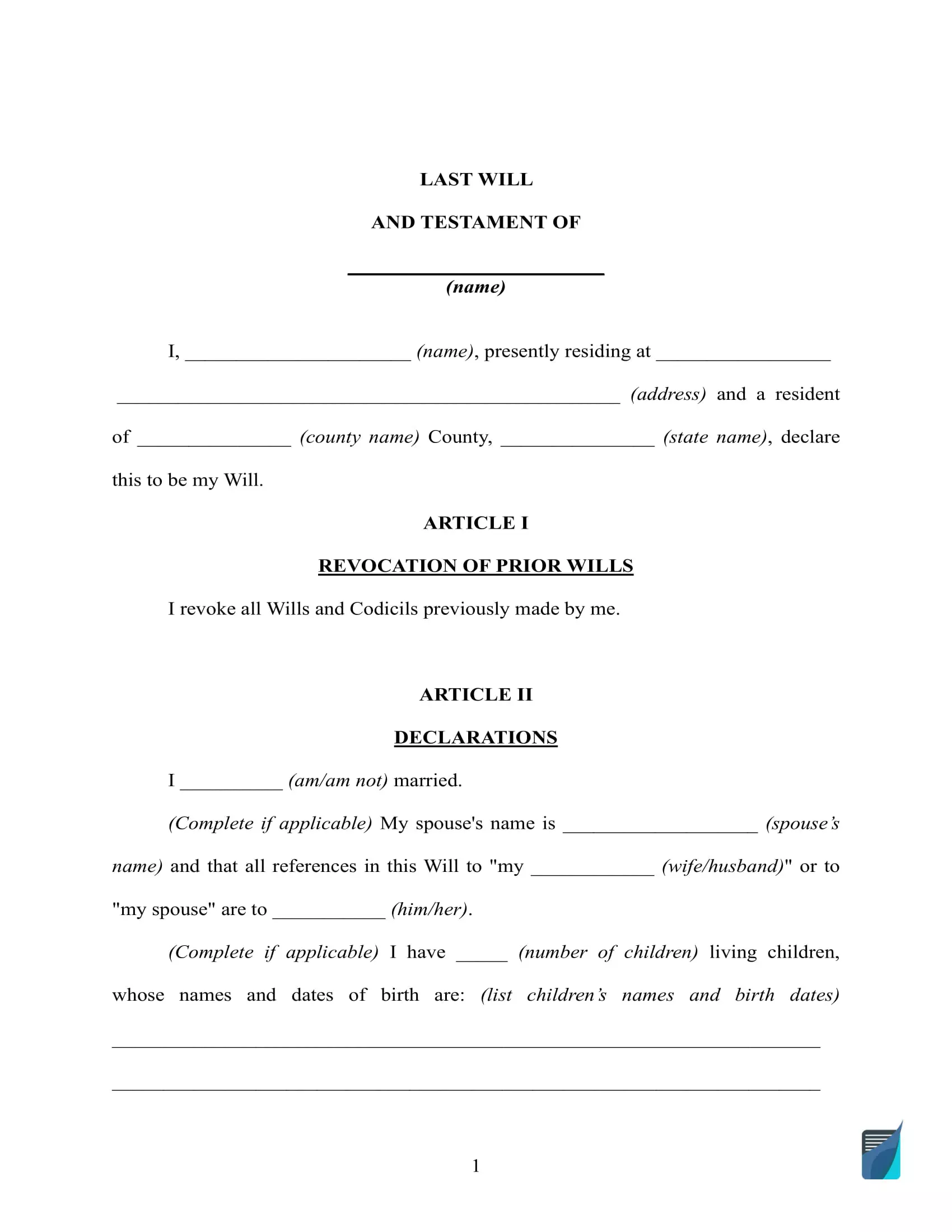
Every person will pass away someday. And a lot of you may wonder how to make your last wishes respected and fulfilled. We understand that it’s an essential matter. That’s why we’ve created the database of last will and testament forms. A Last Will and Testament Form (also referred to as a “Last Will” or simply a “Will “) is a document created by an individual, also known as the “Grantor” or “Testator,” which is used to lay out how a person’s real and personal property shall be distributed after their death. The document is an effective tool to manage the testator’s estate according to their wishes. That’s how you can be sure that your property and assets will be settled only in respect of your desires. Last will and testament requirements may vary by state in terms of signing. The forms below are state-specific, so you can choose your variant and fill out all the relevant information. If the testator’s property is of small value, they can create small estate affidavit, a small estate affidavit form that will quicken the probate process. However, this form depends heavily on state regulations, so you need to consult them before preparing a last will or a small estate affidavit.
If you live in Florida, you should prepare a Last Will and Testament valid in Florida. You are allowed to create the document if you are 18 years old or an emancipated minor and of sound mind. Your last will must be in writing, typed on a computer and printed. Handwritten wills are not recognized in Florida. The testator must sign a Florida will in the presence of two credible witnesses who must sign the document as well. Notarizing the document is optional.
Texas residents may take advantage of a Texas Will Template. The testator must be of legal age, that is, 18 years old. However, this doesn’t apply to a married person or the one who serves in the military. A last will and testament must also be prepared voluntarily, under no duress or coercion. Like in Florida, in Texas, you must sign your last will in the presence of two disinterested witnesses who, in their turn, sign your document. Texas law recognizes handwritten wills.
California residents can use a California Will to outline their final wishes regarding their estate division and funeral arrangements. A California will allows you to distibute your assets between individuals, corporations, or societies. With a last will, you can appoint guardians for minor children or elder relatives. California law recognizes both printed wills and holographic, or handwritten, wills. In California, two disinterested witnesses must also sign your last will and testament.
A NC Will Template can come in handy if you permanently live in North Carolina. This document is used as an essential estate-planning tool to ensure that your property is distributed according to your wishes. A will in North Carolina also helps the testator manage their digital assets. To get a valid document, NC residents must sign the last will and testament in the presence of two competent witnesses.
Last Will and Testament Forms by State
Although state laws do not require a last will document, it’s highly recommended to prepare one. Without such a document, the laws of your state will decide how to distribute your property and assets. As a rule, your estate will be granted to your spouse, children, or parents. Thus, your children from previous marriages might not receive the inheritance. Additionally, the court may appoint unwanted guardians for your minor children or pets. If you don’t have a valid last document, you also lose the possibility of arranging your funeral.
As to signing requirements, they may differ depending on the state you reside in. But in most cases, you will have to sign the document in the presence of two disinterested witnesses. “Disinterested” means that your witnesses cannot be the beneficiaries of your estate. Some states may also require signing in the presence of a notary public. For example, in New Jersey you may sign NJ last will before a notary public to make the document “self-proving.” You are free to select your state-specific last will and create a quality document just in minutes.
- Alabama
- Alaska
- Arizona
- Arkansas
- Colorado
- Connecticut
- Delaware
- Georgia
- Hawaii
- Idaho
- Illinois
- Indiana
- Iowa
- Kansas
- Kentucky
- Louisiana
- Maine
- Maryland
- Massachusetts
- Michigan
- Minnesota
- Mississippi
- Missouri
- Montana
- Nebraska
- Nevada
- New Hampshire
- New Mexico
- New York
- North Dakota
- Ohio
- Oklahoma
- Oregon
- Pennsylvania
- Rhode Island
- South Carolina
- South Dakota
- Tennessee
- Utah
- Vermont
- Virginia
- Washington State
- West Virginia
- Wisconsin
- Wyoming
Sample Last Will and Testament:
Other Forms Related to Last Wills
A last will and testament document can be amended or changed whenever the testator desires. A Codicil to Will Form is used for this purpose. The procedures are the same as when creating the will. The codicil must indicate the original document information and describe in detail what is changed or amended. Then, it must be signed in the presence of two competent witnesses (and sometimes, a notary public) who sign the document for their part.
A Self Proving Affidavit Form will come in handy if you want to prove the will’s or codicil’s authenticity. Like with every affidavit document, a self-proving affidavit helps you confirm under oath that the written statement is accurate and true. In this case, this statement verifies that the will is created by the testator and signed in the presence of two competent witnesses. A self-proving affidavit may facilitate and speed up the probate process.
THE CHURCH TODAY
A Meditation by Vicar Bishop Ioan Casian of Vicina
“And the Word became flesh and dwelt among us, and we beheld His glory, glory as of the Only Begotten of the Father, full of grace and truth” (John 1:14).
NEWS
Central USA Deanery Assembly, South St. Paul, MN
Priests and parish delegates of U.S. Central Deanery met in the weekend of 16 and 17 of September 2011 at St. Stephen’s parish in South St. Paul, MN for the Deanery Assembly. The Assembly work session was opened on Friday afternoon with a prayer of blessing pronounced by His Eminence Archbishop Nicolae.
Help Orthodox Clergy in the Mission Field by Supporting OCMC’s SAMP Program
The light of Orthodoxy shines around the world and is often embodied in priests that minister to diverse cultures in some of the poorest countries. Priests serving in these parts of the world strive to establish vibrant ministries and address the physical and spiritual needs of people who may have never before heard Christ’s life-saving message of hope and salvation.
The Annunciation Cathedral in Rocky River, OH celebrated
The faithful of the Annunciation Cathedral in Rocky River, OH have spent the past weekend in celebration. Everyone prayed, thanked God and asked His blessing on the occasion of the 75th anniversary of the parish, along with H.E. Archbishop Nicolae and Rev. Fr. Ion Gherman.
Archbishop Dimitri of the Orthodox Church in America Reposes in the Lord
DALLAS, TEXAS – [Diocese of the South OCA] His Eminence, Archbishop Dimitri (Royster) retired Archbishop of Dallas and the Diocese of the South of the Orthodox Church in America, fell asleep in the Lord at his home here at 2:00 a.m. Sunday morning, August 28, 2011. His Eminence, The Archbishop was eighty-seven years old.
OrthodoxJobs.com – new and improved website for the job seeker and employer
Boston, MA – August 8, 2011 – The Department of Internet Ministries of the Greek Orthodox Archdiocese and the Office of Vocation & Ministry of Hellenic College are pleased to announce the launch of the redesigned and updated web site.
TODAY’S SAINTS
SEP 23
† Zamislirea Sf. Prooroc Ioan Botezatorul
† Sf. Cuv Xantipa si Polixenia.
ARCHBISHOP NICOLAE’S PASTORAL ITINERARY
September 25, 2011 – Divine Liturgy at the same parish
September 23, 2011 – Deanery Assembly for Eastern Canada at the All Saints parish, Toronto, ON
September 18, 2011 – Divine Liturgy at the same parish
September 16, 2011 – Deanery Assembly for Central USA at St. Steven parish, South St. Paul, MN
September 14, 2011 – Elevation of the Holy Cross Church – Divine Liturgy at St. Nicholas parish, New York
BISHOP IOAN CASIAN’S PASTORAL ITINERARY
September 25, 2011 – Divine Liturgy at the same parish
September 23, 2011 – Deanery Assembly for Eastern Canada at the All Saints parish, Toronto, ON
September 18, 2011 – Divine Liturgy at the same parish
September 16, 2011 – Deanery Assembly for Central USA, South St. Paul, MN
September 14, 2011 – Elevation of the Holy Cross – Divine Liturgy at the Protection of the Mother of God Monastery, Wentworth, QC
Our Faith
The Orthodox Church throughout the ages has maintained a continuity of faith and love with the apostolic community which was founded by Christ and sustained by the Holy Spirit. Orthodoxy believes that she has preserved and taught the historic Christian Faith free from error and distortion, from the time of the Apostles. She also believes that there is nothing in the body of her teachings which is contrary to truth or which inhibits real union with God. The air of antiquity and timelessness which often characterizes Eastern Christianity is an expression of her desire to remain loyal to the authentic Christian Faith.
Orthodoxy believes that the Christian Faith and the Church are inseparable. It is impossible to know Christ, to share in the life of the Holy Trinity, or to be considered a Christian apart from the Church. It is in the Church that the Christian Faith is proclaimed and maintained. It is through the Church that an individual is nurtured in the Faith.
God is the source of faith in the Orthodox Church. Orthodoxy believes that God has revealed Himself to us, most especially in the revelation of Jesus Christ, whom we know as the Son of God. This Revelation of God, His love, and His purpose, are constantly made manifest and contemporary in the life of the Church by the power of the Holy Spirit.
The Orthodox Faith does not begin with humankind’s religious speculations, nor with the so-called “proofs” for the existence of God, nor with a human quest for the Divine. The origin of the Orthodox Christian Faith is the Self-disclosure of God. Each day the Church’s Morning Prayer affirms and reminds us of this by declaring: “God is the Lord and He has revealed Himself to us. ” While the inner Being of God always remains unknown and unapproachable, God has manifested Himself to us; and the Church has experienced Him as Father, Son, and Holy Spirit. The Doctrine of the Holy Trinity, which is central to the Orthodox Faith, is not a result of pious speculation, but the over whelming experience of God. The doctrine affirms that there is only One God in whom there are three distinct Persons. In other words, when we encounter either the Father, the Son, or the Holy Spirit, we are truly experiencing contact with God. While the Holy Trinity is a mystery which can never be fully comprehended, Orthodoxy believes that we can truly participate in the Trinity through the life of the Church, especially through our celebration of the Eucharist and the Sacraments, as well as the non-sacramental services.
While the Bible is treasured as a valuable written record of God’s revelation, it does not contain wholly that revelation. The Bible is viewed as only one expression of God’s revelation in the on-going life of His people. Scripture is part of the treasure of Faith which is known as Tradition. Tradition means that which is “handed on” from one generation to another. In addition to the witness of Faith in the Scripture, the Orthodox Christian Faith is celebrated in the Eucharist, taught by the Fathers, glorified by the Saints, expressed in prayers, hymns, and icons; defended by the seven Ecumenical Councils; embodied in the Nicene Creed, manifested in social concern; and, by the power of the Holy Spirit, it is lived in every local Orthodox parish. The life of the Holy Trinity is manifested in every aspect of the Church’s life. Finally, the Church, as a whole, is the guardian of the authentic Christian Faith which bears witness to that Revelation.
As Orthodoxy has avoided any tendency to restrict the vision of God’s revelation to only one avenue of its life, the Church has also avoided the systematic or extensive definition of its Faith. Orthodoxy affirms that the Christian Faith expresses and points to the gracious and mysterious relationship between God and humanity. God became man in the person of Jesus Christ not to institute a new philosophy or code of conduct, but primarily to bestow upon us “new life” in the Holy Trinity. This reality, which is manifest in the Church, cannot be wholly captured in language, formulas, or definitions. The content of the Faith is not opposed to reason, but is often beyond the bounds of reason, as are many of the important realities of life. Orthodoxy recognizes the supreme majesty of God, as well as the limitations of the human mind. The Church is content to accept the element of mystery in its approach to God.
Only when the fundamental truths of the Faith are seriously threatened by false teachings, does the Church act to define dogmatically an article of faith. For this reason, the decisions of the seven Ecumenical Councils of the ancient undivided Church are highly respected. The Councils were synods to which bishops from throughout the Christian world gathered to determine the true faith. The Ecumenical Councils did not create new doctrines but proclaimed, in a particular place and a particular time, what the Church has always believed and taught.
The Nicene Creed, which was formulated at the Councils of Nicaea in 325 and of Constantinople in 381, has been recognized since then as the authoritative expression of the fundamental beliefs of the Orthodox Church. The Creed is often referred to as the “Symbol of Faith.” This description indicates that the Creed is not an analytical statement, but that it points to a reality greater than itself and to which it bears witness. For generations the Creed has been the criterion of authentic Faith and the basis of Christian education. The Creed is recited at the time of Baptism and during every Divine Liturgy.